On-Premise AI Contract Review Software for Legal Teams
Project Overview
| Year | 2024 |
|---|---|
| Industry | |
| Duration | 4 months |
| Services |
|
%20(1).svg)
.svg)
.svg)
Challenge
The company’s legal team managed a growing number of contracts stored across different systems and file formats. Lawyers spent hours searching for clauses, checking obligations, calculating claims, and preparing documents manually. The company needed custom AI contract review software that could automate these tasks, integrate with its existing systems, and connect every AI-generated answer to its original source. Confidentiality was a central requirement. Contracts, prompts, and generated documents had to remain within the company’s controlled infrastructure. Key challenges included: manual search across contracts with different formats and structures; time-consuming preparation of demand letters and clause revisions; AI-generated answers that could not be used without clear source references; disconnected document, CRM, and legal workflows; and the need to keep lawyers in control of final legal decisions.
Development journey
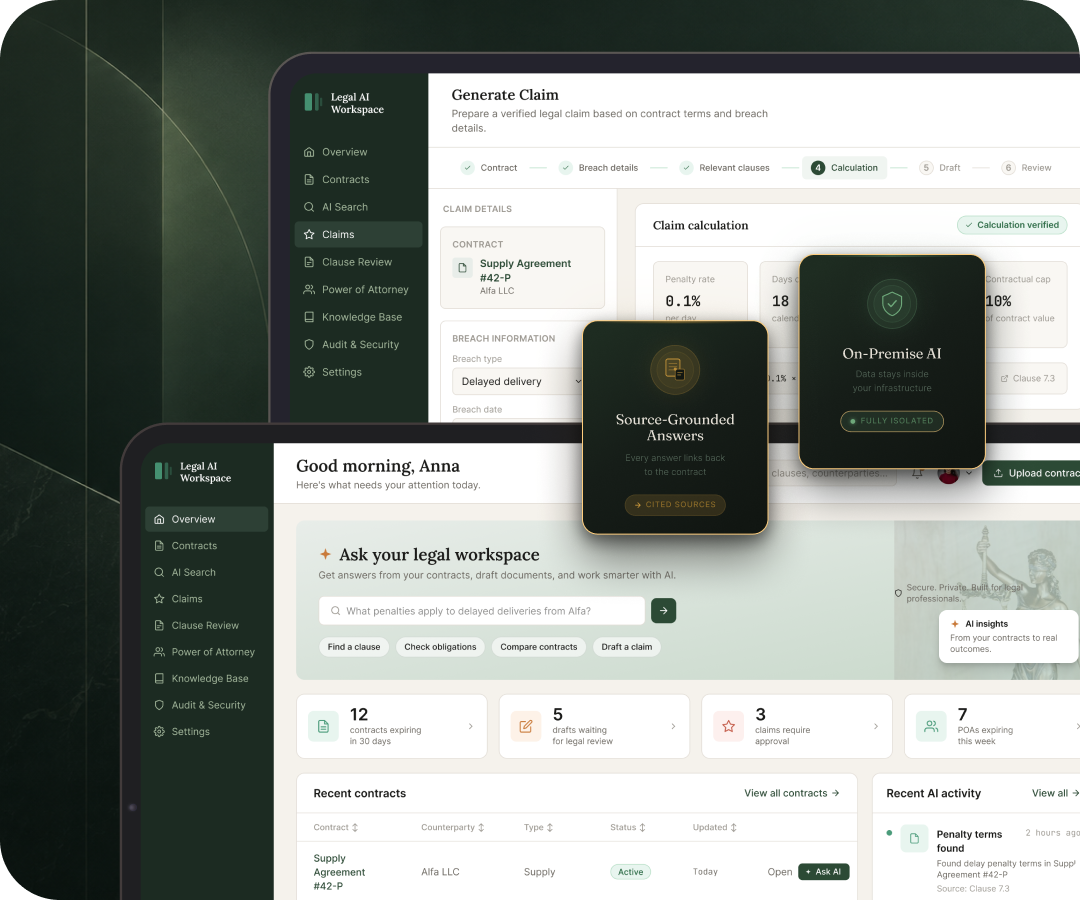
Celadonsoft designed and built an on-premise legal AI platform combining RAG-based contract search, legal document automation, deterministic calculations, and enterprise integrations. The platform turns separate legal tasks into one connected workflow. Contracts are uploaded and indexed, relevant clauses are retrieved, calculations are validated, and documents are generated from approved templates. Lawyers can check the source, edit the output, and approve the final version without leaving the system.
Solution
AI Contract Search: The AI contract assistant finds relevant clauses based on meaning rather than exact keywords. Each answer includes the contract, section, clause, and supporting quotation. Lawyers can open the original document directly and verify the information before using it.
Demand Letter Generator: The user selects a contract and breach type and enters the relevant facts. The platform retrieves the applicable clauses, extracts the required values, calculates the claim, and generates a DOCX document. Before the document reaches the lawyer, the system checks calculations, required fields, contract references, and document structure.
Clause Review & Negotiation: Lawyers can select disputed clauses and generate alternative wording based on approved templates and internal guidelines. The interface shows the original and proposed versions side by side, supports manual editing, and saves the complete history of changes.
Document & Knowledge Base: Contracts and generated documents are stored in a centralised knowledge base. Original files are kept separately from their vector representations, while every indexed fragment remains connected to its source and metadata. The architecture supports document collections ranging from hundreds to tens of thousands of contracts.
Enterprise Integrations: REST APIs connect the contract analysis software with existing DMS, CRM, ERP, and internal reference systems. Corporate SSO and role-based permissions control access to documents and platform functions.
Technical implementation
The web application communicates with a central AI orchestration layer that manages document retrieval, model interactions, calculations, and specialised legal workflows. Original and generated documents are stored separately from their embeddings. Operational data, source metadata, and document versions remain connected throughout the workflow, making every result traceable. The LLM, vector database, document storage, and application services are deployed inside the company’s controlled environment. Security measures include corporate SSO through LDAP or Active Directory, role-based access control, data isolation between departments, audit logs for user and document actions, load testing and penetration testing before production rollout, and no confidential contracts, prompts, or AI outputs are sent to public model providers.
Key engineering decisions include source-grounded RAG (answers come from the company’s own contracts rather than general model knowledge), deterministic business logic (the LLM extracts contract values and conditions, while separate services perform calculations and validation), human-in-the-loop (an authorised lawyer reviews every final document and clause revision), and modular architecture (search, document generation, calculations, integrations, authentication, and storage work as separate components).
Results & Impact
- Up to 80% less time spent searching for contracts, required clauses, and related information
- Minutes instead of hours spent preparing demand letters and other legal documents
100% of AI processing takes place within the company’s controlled infrastructure, so confidential contracts, prompts, and generated documents are not sent to public AI services - Every AI-generated answer can be verified against its source, including the original contract, section, or clause
- One controlled workflow for contract search, document preparation, clause revision, and approval reduces manual work and switching between disconnected tools
- Human-in-the-loop approach: AI searches, extracts information, and prepares document drafts, while final legally binding decisions remain with qualified legal professionals
- A scalable foundation for further legal workflow automation, supported by enterprise integrations, access controls, monitoring, and version history